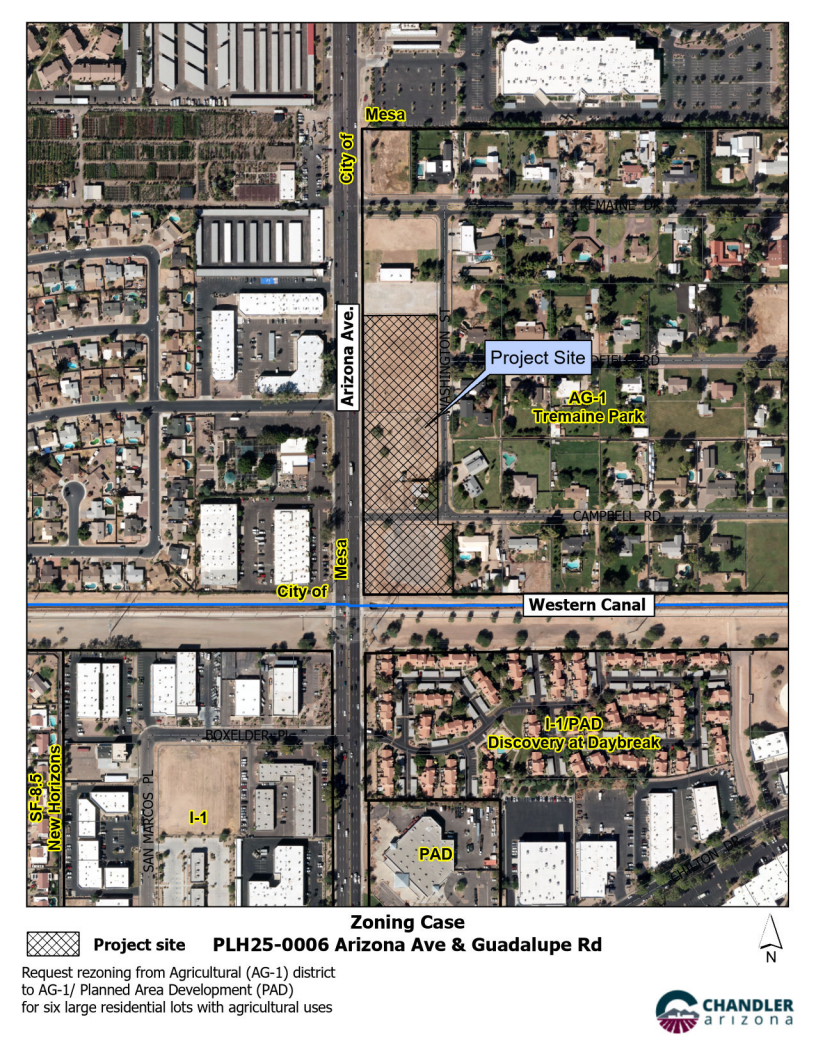
A developer seeking to rezone four lots at Arizona Avenue and Guadalupe Road told Chandler planning officials and neighbors last month that he has no intention of building homes on the property — a revelation that has become the central point of contention in a rezoning fight underway in the Tremaine Park neighborhood.
The Chandler Planning and Zoning Commission is scheduled to take up the matter as a study session item on June 3, the first formal step in a process that began more than four years ago when Babcock-Drevitson RE1 LLC, controlled by Ross Babcock, acquired three of the last undeveloped lots in the 1968 subdivision.
The request is modest on its face: rezone 6.05 acres from AG-1 (Agricultural District) to AG-1 PAD (Planned Area Development) so the developer can split Lots 17, 31, and 46 of Tremaine Park into six single-family lots ranging from roughly three-quarters of an acre to just under an acre. The proposed average lot size of 36,520 square feet is below the 43,000 square feet normally required under AG-1, but consistent with most of the lots already built out in Tremaine Park, where 77% of parcels are smaller than the community's original average, according to the development narrative.
Side yard setbacks would be cut in half, from 30 feet to 15 feet. An 8-foot decorative wall would be built along Arizona Avenue — a deviation from Chandler's 7-foot fence height limit — to buffer the new homes from traffic noise. The developer's team argues the wall is a benefit to existing residents.
But the opposition, led by 10-year Tremaine Park resident Robin Anderton, isn't focused on the wall or the lot sizes. Instead, the dispute centers on whether the city should rezone land for a developer who says he isn't planning to build.
'No intention to build'
At a community meeting on April 22, 2026, attended by Chandler planning staff, Babcock stated publicly that he has no intention of building homes on the lots, according to a letter of opposition filed with the city. The rezoning would instead increase the property's marketability for sale — a speculative play that Anderton argues subverts the city's zoning process.
"I am opposed to any re-zoning request by a party that has proclaimed no intention to build," Anderton wrote in the letter, which was submitted to the Planning and Zoning Commission. "The city's zoning process should approve changes when there is a concrete development proposal so that necessary mitigations and conditions can be imposed."
Approving speculative rezoning, Anderton wrote, "shifts the burden of future impacts onto residents and reduces the city's ability to negotiate protections."
The developer's narrative, prepared by CVL Consultants and dated February 19, 2026, describes a future for the site with "new and attractive residential development" and promises that architectural elevations, floor plans, and color schemes "will be submitted for approval by the end user at the time of design review." But it does not commit Babcock-Drevitson to building — the reference to an "end user" suggests homes would be built by whomever buys the lots after rezoning.
A decade of division
Tremaine Park was platted in 1968 with large lots ranging from about three-quarters of an acre to just over two acres. Over the decades, the vast majority of property owners have split their lots — 66 of 86 parcels, or 77%, are now below the original average size. Only six of the original lots remain undivided, excluding the three Babcock-Drevitson owns.
Babcock-Drevitson bought the lots years ago. The properties are among the last undeveloped land in the subdivision. One parcel contains a small building constructed in 1974 that the developer says will be removed.
The project has been in the works since at least February 2022, when the first version of the rezoning narrative was submitted. The current version was revised in February 2026.
The restrictive covenant
Tremaine Park's recorded restrictive covenants, filed with Maricopa County in 1982, include a restriction that directly affects the rezoning proposal. Section 2 states: "None of said lots shall be resubdivided into lots smaller than nor conveyed or encumbered in less than one (1) commercial acre."
The developer's narrative acknowledges the covenant and asserts that the proposal "is consistent and compliant with the existing CC&R's in terms of conformance to minimum lot sizes meeting or exceeding a 'commercial acre' and comparable in size to the majority of the existing lots in Tremaine Park, most of which have been split."
But the lots proposed for subdivision fall into a range where the definition matters. Lots 5 and 6, at 33,002 and 33,803 square feet respectively, are smaller than the 36,000 square feet commonly defined as a commercial acre in Maricopa County. Lots 1 through 4, at roughly 38,000 square feet each, exceed that threshold. The neighboring property owners who signed the 1982 covenants agreed that no lot would be subdivided below that commercial acre mark.
The CC&Rs also require that any new structure's "design and location" and "kind of materials" be approved by a three-person committee of lot owners elected by the neighborhood. If no committee acts within 30 days, the design must be "in harmony with existing buildings and structures in the immediate vicinity." The rezoning to PAD would modify city zoning standards — including side yard setbacks cut from 20 feet to 15 — but the CC&R committee's authority would still apply to any future builder who buys the lots.
Septic and sewer
A secondary issue that emerged during the August 2025 neighborhood meeting involves wastewater. Many Tremaine Park homes rely on septic systems, and neighbors expressed concern that the developer's sewer extension would create an obligation for them to connect at their own cost.
The developer commissioned a Gravity Sewer Feasibility Analysis that concluded only 12 of the 82 parcels in Tremaine Park are viable candidates for future sewer connection. The analysis, sealed November 6, 2025, found that existing finished floor elevations and plumbing outfalls were not designed with future public sewer connection in mind.
Babcock-Drevitson agreed to terminate a sewer payback agreement with the city — recorded February 17, 2026 — and forgo any reimbursements from other Tremaine Park homeowners for costs the developer incurred in extending the sanitary sewer system. The move effectively removes any financial obligation from neighbors.
The broader picture
The Arizona Avenue and Guadalupe Road rezoning is an infill development proposal in a mature Chandler neighborhood, but the developer's "no intention to build" statement makes it an unusual one. In most rezoning cases, developers present a specific plan that the city can condition — for example, requiring the 8-foot sound wall or the sewer abandonment. Here, those conditions would apply to an unknown future builder if the lots are sold.
The Planning and Zoning Commission's June 3 meeting is a study session, not a public hearing. A formal hearing has not yet been scheduled. The next commission meeting is June 17.