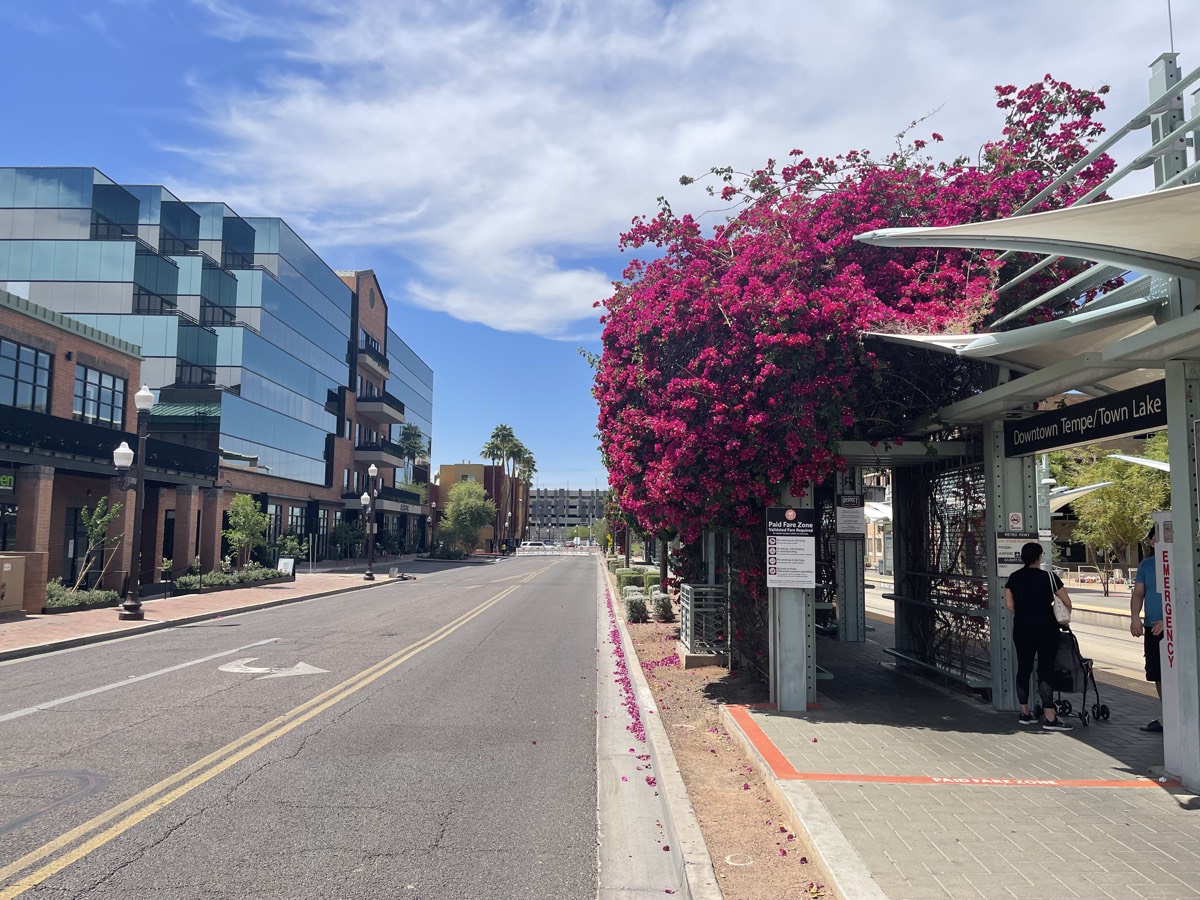
The Tempe City Council on June 4 will hold a first public hearing on a zoning code amendment that reduces parking requirements for properties in the Transportation Overlay District, the area within roughly half a mile of Valley Metro light rail stations. The amendment cuts the minimum number of parking spaces developers must provide for new projects in the overlay zone.
The Transportation Overlay District covers properties from Downtown Tempe south along the light rail corridor. Under the current code, developments in these areas must meet parking minimums similar to sites outside the transit zone — requiring expensive parking garages and surface lots even where transit, biking, and walking are realistic alternatives to driving.
The proposed text amendment reduces those minimum parking ratios. Sections of the code that set the minimum and maximum number of required off-street parking spaces within the overlay will be deleted and consolidated into a new simplified parking section. The existing table of parking reductions available within the overlay zone is also being replaced.
The Development Review Commission recommended approval on May 12. The Council's June 4 hearing is the first of two required public hearings before the amendment can be adopted. A second and final hearing is expected later in June.
Parking requirements add significant cost to new development. Research published by the Victoria Transport Policy Institute shows that structured above-grade parking costs between $20,000 and $40,000 per space, with underground parking reaching $40,000 to $80,000 per space. For a project near a light rail station, each space the code doesn't require is a cost that doesn't get folded into rents or retail prices.
The amendment applies only to properties within the Transportation Overlay District — the transit-adjacent areas where reducing parking requirements has the most effect. Developers building outside the corridor, where driving remains the primary way to get around, would continue to follow the standard code requirements.
The item appears alongside several other development-related ordinances on the June 4 non-consent agenda, including a rezoning for a seven-story mixed-use project at Spence Avenue and Jentilly Lane that heads to a final vote at the same meeting.